


ot summer days are ripe for thunderstorms, but lightning’s blinding flashes and thunder’s booming crashes can frighten young children. In Thunder Cake by Patricia Polacco, a picture book based on Polacco’s childhood, a young girl scurries under her bed when she hears the thunder crack. Comfortingly, her grandmother coaxes her out and enlists her help in making Thunder Cake. They must hurry to gather the ingredients because it must be in the oven before the storm arrives to be a true Thunder Cake.
The story’s words convey the escalating sound of the approaching storm. Grandmother and granddaughter count the seconds between the lightning and thunder to determine how far away the storm is. While collecting the necessary items, the granddaughter must face her fears: intimidating barnyard animals, heights, and dark, eerie woods. She learns that bravery doesn’t mean never feeling fear but choosing to confront it—and it helps when she knows her grandmother is by her side.
Read this comforting story and expand your children’s weather knowledge with these activities while they learn to face any fear of storms.
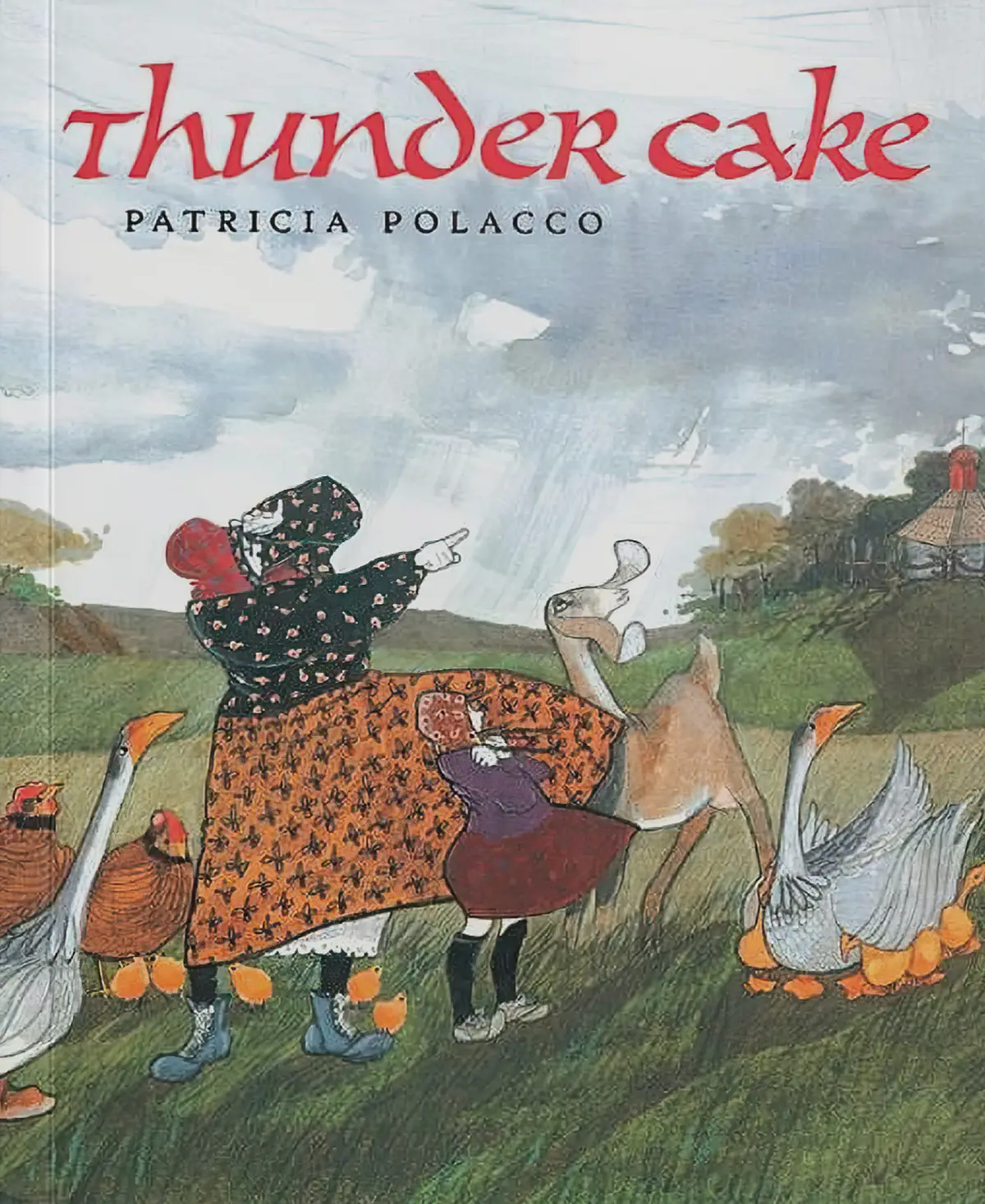
ot summer days are ripe for thunderstorms, but lightning’s blinding flashes and thunder’s booming crashes can frighten young children. In Thunder Cake by Patricia Polacco, a picture book based on Polacco’s childhood, a young girl scurries under her bed when she hears the thunder crack. Comfortingly, her grandmother coaxes her out and enlists her help in making Thunder Cake. They must hurry to gather the ingredients because it must be in the oven before the storm arrives to be a true Thunder Cake.
The story’s words convey the escalating sound of the approaching storm. Grandmother and granddaughter count the seconds between the lightning and thunder to determine how far away the storm is. While collecting the necessary items, the granddaughter must face her fears: intimidating barnyard animals, heights, and dark, eerie woods. She learns that bravery doesn’t mean never feeling fear but choosing to confront it—and it helps when she knows her grandmother is by her side.
Read this comforting story and expand your children’s weather knowledge with these activities while they learn to face any fear of storms.
ot summer days are ripe for thunderstorms, but lightning’s blinding flashes and thunder’s booming crashes can frighten young children. In Thunder Cake by Patricia Polacco, a picture book based on Polacco’s childhood, a young girl scurries under her bed when she hears the thunder crack. Comfortingly, her grandmother coaxes her out and enlists her help in making Thunder Cake. They must hurry to gather the ingredients because it must be in the oven before the storm arrives to be a true Thunder Cake.
The story’s words convey the escalating sound of the approaching storm. Grandmother and granddaughter count the seconds between the lightning and thunder to determine how far away the storm is. While collecting the necessary items, the granddaughter must face her fears: intimidating barnyard animals, heights, and dark, eerie woods. She learns that bravery doesn’t mean never feeling fear but choosing to confront it—and it helps when she knows her grandmother is by her side.
Read this comforting story and expand your children’s weather knowledge with these activities while they learn to face any fear of storms.
Measure Rainfall: To measure rainfall, place a straight-sided glass or jar outside to catch rain. Measure the rain inside the jar with a ruler to determine how many inches fell. Keep track of each day’s rainfall on the weather chart. Which day had the most rain?
Make a Cloud Chart: Demonstrate the types of clouds with cotton balls. Use whole cotton balls to represent cumulus clouds. Gently pull on the cotton balls, unraveling them, and spread them in layers to represent stratus clouds. Tear off wispy pieces to represent cirrus clouds. Glue each type to a piece of paper and label them for an illustration of cloud types.
Explore Rainbows: On a sunny afternoon, go outside and put your thumb over the hose nozzle to make the water fan out in a mist. Turn the hose until the sunlight catches the water just right and you see a rainbow through the mist. Light is made of all colors, but water droplets bend the light to reveal the spectrum of color. You can see the same effect by using a prism.
Discuss Being Afraid: Do your children think the girl in the story was brave? Why? Have they ever had to confront fear of thunderstorms, angry-looking animals, or other intimidating things as the author does? All people face fear. Even Jesus’ disciples—experienced fishermen—were scared during a storm so fierce they feared losing their lives. But Jesus was with them and calmed the storm with His word.
Remind your children that just as the girl in the story felt braver when her grandmother walked with her, we can be brave because Jesus is always with us and will never leave us. Whether we have warm, sunny summer days or stormy ones, we can enjoy Jesus’ presence and learn about the amazing weather systems He created.

et against the backdrop of a summer by the sea, this beautifully written story follows Maureen and Paul as they pursue their dearest wish: owning the Phantom, a wild horse. Along the way, they learn lessons about hard work, perseverance, and growing up.
The story opens as a Spanish ship carries horses to South America. The ship is wrecked and the crew lost, but the horses manage to struggle to the shores of a wild island. The story fast-forwards several centuries as Maureen and Paul Beebe explore the beaches of Assateague Island, located off the coast of Virginia and Maryland. They are discussing the upcoming wild pony roundup.
The yearly roundup is a tradition for Chincoteague Island residents, as well as for the tourists who gather on the island from miles around. After the roundup, some of the ponies are auctioned off and the rest are allowed to return to their home on Assateague Island. The Phantom is one pony, however, that has avoided the roundup every year. The dearest wish of Paul and Maureen is to own the Phantom. Together, they form a plan to earn the money to buy their dream horse.
et against the backdrop of a summer by the sea, this beautifully written story follows Maureen and Paul as they pursue their dearest wish: owning the Phantom, a wild horse. Along the way, they learn lessons about hard work, perseverance, and growing up.
The story opens as a Spanish ship carries horses to South America. The ship is wrecked and the crew lost, but the horses manage to struggle to the shores of a wild island. The story fast-forwards several centuries as Maureen and Paul Beebe explore the beaches of Assateague Island, located off the coast of Virginia and Maryland. They are discussing the upcoming wild pony roundup.
The yearly roundup is a tradition for Chincoteague Island residents, as well as for the tourists who gather on the island from miles around. After the roundup, some of the ponies are auctioned off and the rest are allowed to return to their home on Assateague Island. The Phantom is one pony, however, that has avoided the roundup every year. The dearest wish of Paul and Maureen is to own the Phantom. Together, they form a plan to earn the money to buy their dream horse.
A variety of adventures beset Paul and Maureen. A storm strikes, disappointment occurs, and their love for the Phantom almost manages to damage their relationship. Through it all, however, they learn the benefits of hard work, the value of perseverance, and the importance of self-sacrifice. Their constant interaction with kind and loving adults such as Grandpa and Grandma Beebe provides them with opportunities to learn and practice respect and obedience. Paul and Maureen are continually provided with wise advice and guidance from the adults they meet.
Paul and Maureen begin to understand that difficulties, and even pain, are a part of growing up. However, they also begin to realize that through perseverance, great things can be accomplished. Indeed, by the end of the book, their dream has been realized in an exciting, although unexpected, way.
Overall, Misty of Chincoteague is a great book for children to read individually or for a family to read aloud. The lessons that Paul and Maureen learn reinforce a variety of scriptural principles. Their friendship and adventures together paint a beautiful picture of sibling harmony. Their relationships with their grandparents and other adults provide children with examples of respect, humility, and obedience. Marguerite Henry’s book is a family treasure indeed!
This instance gives an opportunity to talk to your children about the importance of obeying even when they may not feel like it. Perhaps they could memorize a verse such as Deuteronomy 6:3 together. This would even be a good opportunity to talk about the obedience of Christ to His Father and the blessings that resulted for mankind.
There are a number of potential research topics contained in the story. For example, are there any other theories for the origin of the ponies on Assateague? What other animals reside on the island of Assateague? Could the wild ponies be managed by the residents of Chincoteague in a better or more efficient way?