

 Enhanced – Watch: the review video
Curriculum Consultants
Gina Burmeier &


Need something to keep those library books all in one spot? Plastic Book Bins ② by Storex come in small or large sizes and in many different colors. These book bins are made of sturdy plastic and feature front and rear handles for easy gripping and carrying, even for little hands. Sides of bins link together for compact, safe storage.
Reusable Dry Erase Pockets ③ by C-Line® save paper, time, and money. Pages insert from the top, so you can easily slip in single, loose-leaf worksheets or even fold thin workbooks to the desired page and slide them in. Use dry-erase crayons or markers and, when the lesson is completed, wipe off the pocket to use again. The edges of the pocket are stitched with opaque, colored plastic binding and there is a grommet at the top of the pocket. 9” x 12” pockets actually measure 10” x 13.5” and are available separately or in a kit with two dry erase pockets, a set of four dry erase crayons, and 10 pre-printed education templates with letters to trace, a clock face, and more. Also available is a 12” x 9” side loading pocket that is great for landscape-oriented papers, or a 6” x 9” for half-size sheets of paper or small booklets.

The File-It Wall Calendars ⑤ from LANG serve as a calendar and an organizational tool! The beautiful 12” x 12” calendars have a Wire-O binding so you can easily flip it. Every month also has a pocket for storing papers or documents. The ‘Notes’ section on the back of every month’s page allows you to label what is inside. Simply tear off the month when it is completed, fold over the tab to keep your documents safe, and file away! Available in a Butterflies™, Botanical Gardens™, or Ladybird™ theme.

Now in its fourth edition, the Class Lesson Planner ② by Christian Liberty Press not only provides a place for you to record weekly lessons, but is also a resource for so many other organization and scheduling strategies. This simple, meaty planner is full of valuable information for the homeschool parent. The beginning of the planner includes specific instruction on how to divide up your course work for the year and explains (with examples) three different scenarios of possible schedules. Then there is a month at-a-glance calendar followed by the lesson plan pages. Each week is a 2-page spread offering room for 10 subjects (allowing you to break down language arts or other desired subjects) for 40 weeks of planning. In the back are grading logs with instructions, report cards, health forms, transcript forms, and more—even a section about college/career planning. Designed to be used with one child, this resource will make it easy for you to stay organized and document your child’s academic progress from year to year.
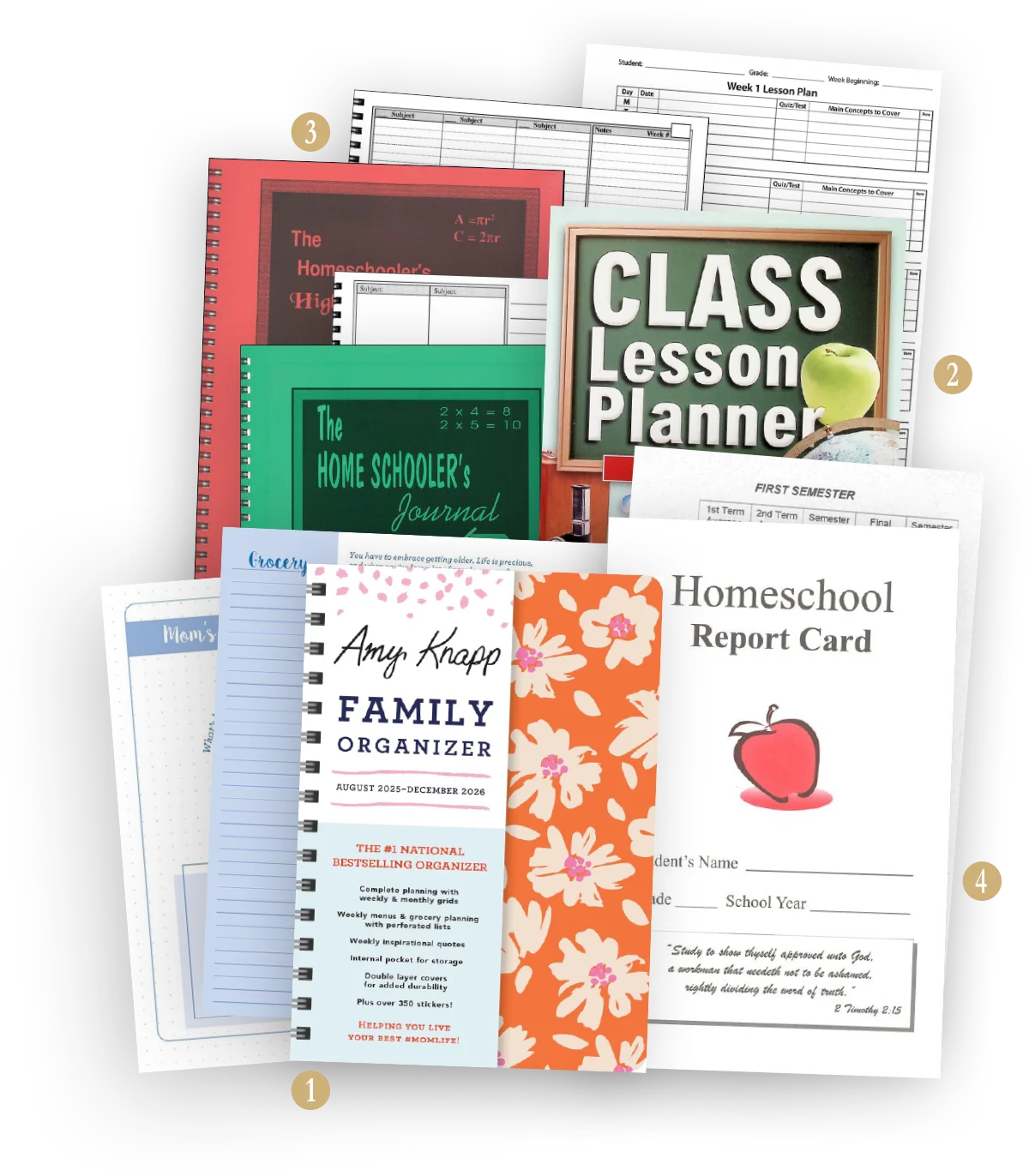
Academic Advantage offers record keeping tools to keep track of grades. Home School Report Cards ④ are a simple report card printed on sturdy cardstock. On the front, there are blanks to record the student’s name, grade and school year and either a Bible verse or famous quote. Inside of the report card is an academic progress chart on the left-hand side and a character development chart on the right. The academic progress chart lists 8 subject areas (Bible, reading, math, English, spelling, penmanship, science, and history/geography) and three blank spaces to record additional studies. To the right of each subject are four blank boxes for you to record the grades earned in that subject each quarter of the year. Below the chart is a grading scale. The character development chart is very similar listing personality traits with an explanation of the symbols used to “grade” their character. The backside of the card has a short sentence with blanks in the appropriate places stating the student has been promoted to the grade under supervision of the parent’s signature.
The High School Report Card holds blanks to record the student’s name, grade, and school year, as well as a grading scale. The two inside pages are identical charts for two different semesters. There are spaces to fill in eight different subjects per semester, the grades earned for each quarter, the midterm exam, the final exam, and credits earned. The back page is a chart for listing the textbooks used that year.
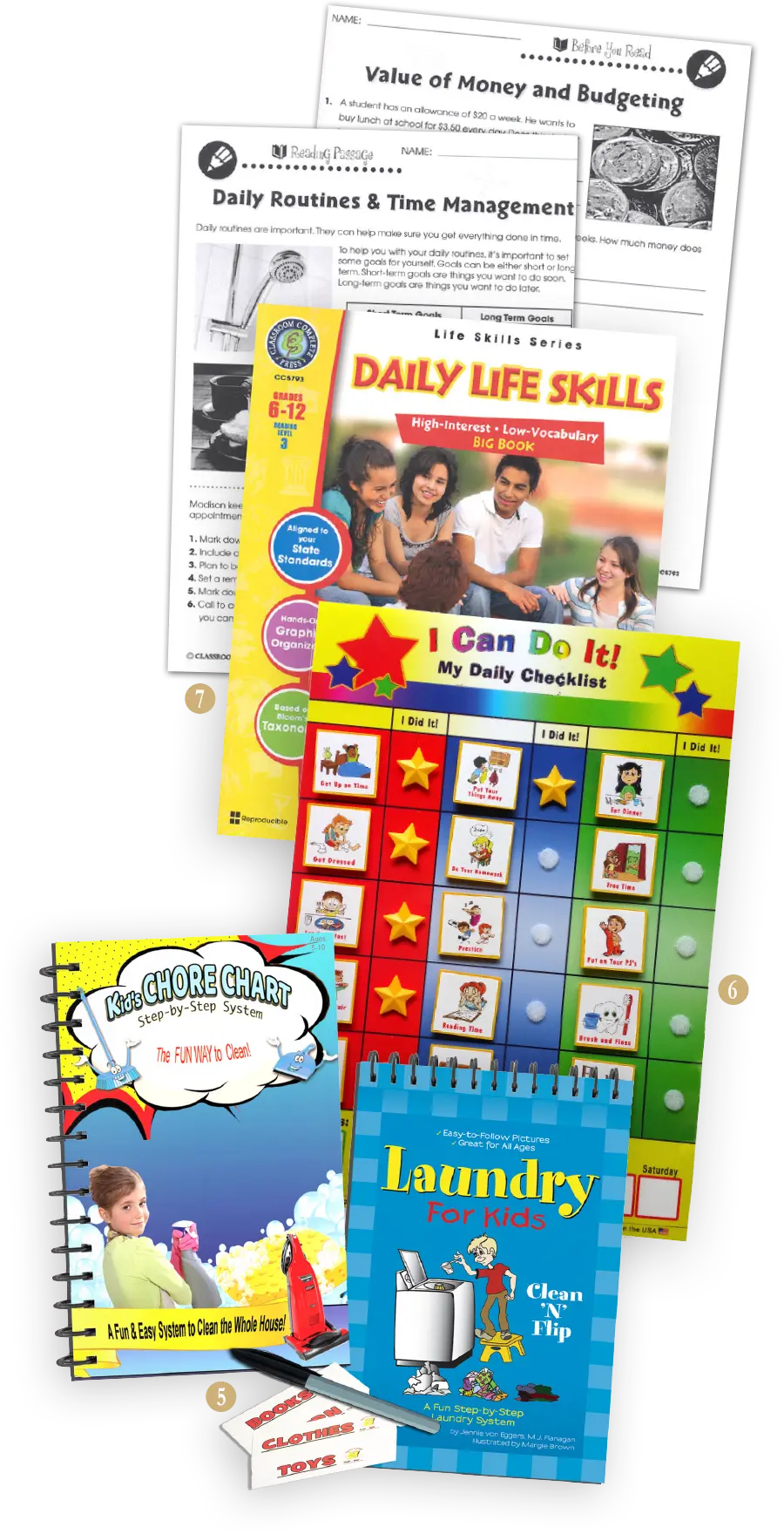
Children thrive on praise and many parents find a little incentive goes a long way toward motivating them. I Can Do It! My Daily Checklist ⑥ by Kenson Kids is laminated and comes complete with 11×15.5″ chart, magnetic strips and hang tabs, 1 dry erase marker w/ clip, 18 reusable plastic stars, 35 task markers, 5 blank labels, and suggestion guide. Stars and task markers are attached with hook and loop dots. There are three columns of five tasks for a total of 15. Next to each task is space for rewards stars when the task is completed. There is space at the bottom of the chart to record how many stars are earned each day of the week.
For the older student, making sure they know basic life skills is essential. Daily Life Skills Series ⑦ by Classroom Complete Press is a handy series. This series helps your children learn basic life skills. These ready-to-use lessons cover a variety of topics that are useful: Daily Marketplace Skills, Daily Social & Workplace Skills, and Daily Health & Hygiene Skills. Students will start by going into the marketplace and learning how to budget and how to best spend their money. Then, students go into the workplace and learn how to behave in a social environment. Finally, students go back to their home and learn about health and hygiene. Comprised of reading passages, graphic organizers, real-world activities, crossword puzzles, and word search and comprehension quizzes, this resource combines high interest concepts with low vocabulary to ensure all learners comprehend the essential skills required in life. All of the content is aligned to your State Standards and are written to Bloom’s Taxonomy. Each 60-page book includes the teacher/parent instruction and activity pages with examples for the students. These are also reproducible for family or classroom use.
Another option is The Ultimate Homeschool Physical Education Game Book ② from Educators Press which provides fun and easy-to-use games and activities that will give your children great exercise and instill in them a lifelong love of fitness. It contains games that do not require a gym, expensive equipment, or large play areas. Most can be played in a backyard setting. However, many basketball games require a hard surface for dribbling and games like handball and wall ball require bouncing balls off a wall. The only equipment these games call for, besides a few racquets, nets, and hula-hoops, are different kinds of balls. Some of the games that require specific equipment give ideas for substitutions that can be made if the equipment is not available. Most of the games can be played with 2-4 people but can easily be adapted for larger groups. The skill-based games work on improving specific sport skills and also introduce activities children will enjoy doing independently. Parents will find helpful advice on how to use the games most effectively in a homeschool setting, how to introduce games to children, finding the right game to achieve your learning objective, safety guidelines, and much more. The book is a great resource for fun and simple games that will prompt your children to enjoy physical activity and will develop their fitness, movement, and sport skills.
303 Kid Approved Exercises and Active Games ③ from Hunter House comes in three age levels (PK–K, Grades 1–3, and 4–6) This is a fun resource for homeschooling families and co-ops, teachers, camp counselors, coaches and youth group leaders. All activities were kid-tested and chosen as their favorites. Make physical fitness fun as they learn to follow directions, focus, reason, share and even develop self-control. Icons are attached to each activity so parents & teachers know how to plan for space, group size, music & equipment.
Stress-Reducing Activities for Teens ④ from Mark Twain Media is filled with activities like journaling, coloring & doodling, grounding exercises, brain teasers, making vision boards, and more to help students cope with the stresses of life. Targeted for grades 6 and up, each section starts by giving the parent a description of how the activity can be used to improve mental and physical health. Then there are directions on how to complete each activity. What a great resource to reduce stress, improve health, and work on life skills!


You don’t have to go out and buy a drum set to learn to play the drums. Many items around the house can be a “sound source”, or drum, according to this Kid’s Drum Course 1 Starter Kit ⑥ from Alfred Publishing. This introductory drum course covers instruments, drumsticks, beats, music notation, rhythm, 4/4, 2/4, and 6/8 time signatures, coordination, and syncopation too. Before you pick up those sticks, however, the first several pages of the book discuss other rhythm objects and instruments that can be used in place of a traditional drum set. Once you’ve found an instrument that will work for you, it’s time to start developing your skills in counting beats, and learning musical notation. Along the way, simple practice songs and easy traditional songs are included, offering kids practice making real music. Most practice songs are included in the accompanying online audios, so students can hear what the drum music should sound like and follow along if they want to. This is a great introduction to playing drums that won’t cost you a bundle.
Another hit are the Handbell Sets ⑦ from Rhythm Band® Instruments. The bells are 5″ tall with long handles for easy gripping, and each has note names and numbers clearly marked on the top of its handle. The metal bells are all different colors and feature springs inside that are durable and make it easy to control playing. There are a variety of sets to choose from so you can be sure to get the bells you need to make the music you want. The bright colors and clear sounds of these bells are sure to delight musicians of all ages. Make beautiful music with these high-quality bell sets that can be enjoyed by the whole family.
Happy homeschooling!

ina Burmeier and her husband homeschooled their three kids using many Charlotte Mason and classical programs. Realizing all three kids were very different, taking an eclectic approach gave them a great opportunity to meet all their children’s needs. For years, they traveled together as a family to homeschool conventions representing Rainbow Resource Center. She has thoroughly enjoyed meeting and talking with many homeschoolers over the years. With all three kids now college graduates, she is a consultant in the office at Rainbow and continues to enjoy helping homeschoolers with curriculum questions. She is very passionate about researching curriculum and learning styles as she helps other homeschoolers find the best fit for their children.

mber Garcia studied Elementary Education and music at Bible college. There she met her husband and began the journey of ministry and family. Giving their four children a Christian education became the focus and they purposed making that happen by putting them in a Christian school where they were teaching some years and homeschooling other years. Now Amber is a homeschool consultant at Rainbow Resource Center helping other homeschoolers with curriculum questions. Amber loves finding the key to help each student learn in their own way.